
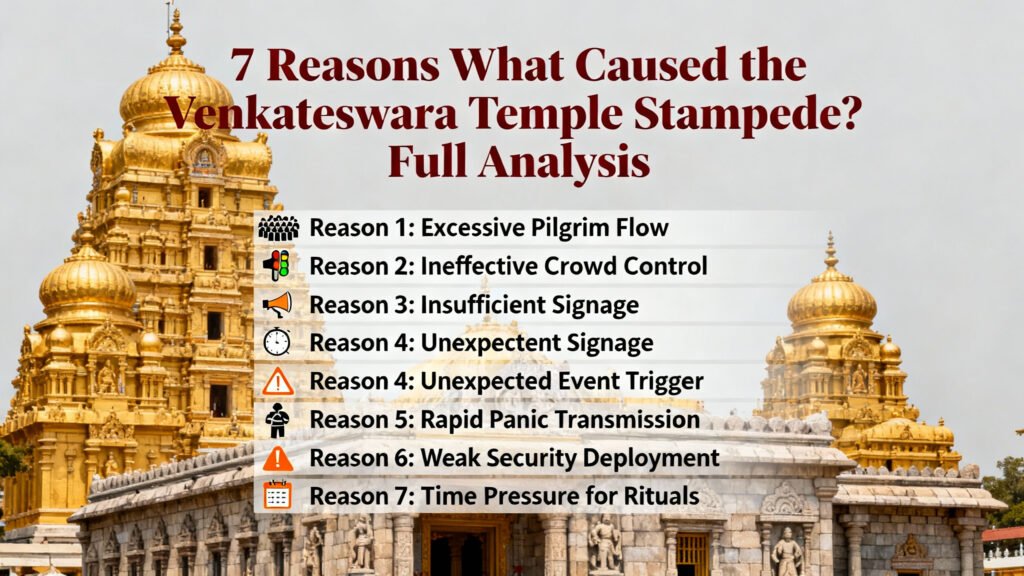

The Venkateswara Temple stampede in Andhra Pradesh’s Srikakulam district claimed at least nine lives and injured several others when thousands of devotees gathered for Ekadashi celebrations on Saturday. This devastating temple stampede causes investigation reveals a perfect storm of management failures, overcrowding, and inadequate safety measures that turned a religious gathering into a deadly tragedy.
This comprehensive Tirupati stampede analysis is for anyone seeking to understand how religious gathering stampede incidents occur and what can be done to prevent them – from temple administrators and government officials to devotees and safety experts concerned about crowd management at religious sites.
We’ll examine the key factors that created this deadly stampede, including the critical crowd management failure where 15,000-25,000 people showed up at a temple designed for just 2,000-3,000 devotees. You’ll also discover how management failures escalated the crisis, from using the same entry and exit points to organizing events without official approval on private temple grounds still under construction. Finally, we’ll break down the political blame game and accountability issues that emerged as officials pointed fingers while families mourned their losses.
Key Factors That Led to the Deadly Stampede
Single Entry and Exit Point Created Dangerous Bottleneck
The Venkateswara temple stampede was significantly exacerbated by a critical infrastructure flaw: both the entry and exit points of the temple were the same. This design created a dangerous bottleneck that proved fatal when thousands of devotees attempted to move through the limited passage simultaneously. The single-point access system forced incoming and outgoing crowds to converge at the same location, creating inevitable congestion and increasing the risk of crowd crush incidents.
This structural limitation became particularly hazardous during the Ekadashi festival when devotee numbers surged far beyond normal capacity. The shared entry-exit configuration prevented efficient crowd flow management and eliminated escape routes during the emergency, trapping devotees in a confined space with no alternative passages for safe evacuation.
Overcrowding with 15,000-25,000 Devotees in Limited Capacity Temple
The temple, known locally as “Chinna Tirupati” (small Tirupati), typically accommodates around 10-15,000 devotees every Saturday under normal circumstances. However, the Ekadashi occasion drew an extraordinary crowd of approximately 25,000 visitors – nearly double the usual capacity. This massive surge in attendance overwhelmed the temple’s infrastructure and crowd management capabilities.
Temple officials attributed this unprecedented rush specifically to the religious significance of Ekadashi, which draws devotees seeking special blessings. The dramatic increase from the regular 15,000 to 25,000 devotees created a dangerous overcrowding situation that the temple’s existing facilities simply couldn’t handle safely. The limited space became critically overcrowded, setting the stage for the tragic stampede that followed.
Collapse of Iron Railing Under Crowd Pressure
A pivotal moment in the tragedy occurred when an iron railing in the darshan queue collapsed under immense crowd pressure. As devotees jostled and pushed forward to move ahead in the line for deity darshan, the metal barrier gave way, causing people to lose their balance and fall over each other. This railing failure acted as the immediate trigger that transformed an overcrowded situation into a deadly stampede.
The collapse created a domino effect where falling devotees caused others to stumble and fall, resulting in people being trampled in the ensuing chaos. This structural failure highlighted the inadequate crowd control infrastructure that couldn’t withstand the pressure from the massive gathering of devotees.
Construction Area Added to Unsafe Conditions
The area where pilgrims assembled was still under construction at the time of the stampede, creating additional safety hazards. This ongoing construction work meant that the space lacked proper safety measures, adequate barriers, and finished infrastructure necessary for managing large crowds safely. The incomplete construction site presented uneven surfaces, exposed materials, and potential obstacles that increased the risk of accidents.
The combination of construction debris, unfinished pathways, and temporary structures created an inherently unsafe environment for handling the massive influx of devotees. The organisers failed to account for these construction-related hazards when allowing such large gatherings to proceed in an incomplete venue, ultimately contributing to the severity of the stampede incident.
Management Failures That Escalated the Crisis
Private Temple Operated Without Official Approvals
The Venkateswara temple stampede causes directly trace back to the temple’s unregulated private operation. The Sri Venkateswara Swamy temple in Kasibugga was constructed and managed entirely by 80-year-old landlord Mukunda Panda on private land, operating outside the purview of the state’s Endowments Department. State Endowments Minister Anam Ramanarayana Reddy explicitly confirmed that “the Kasibugga Venkateswara Temple in Srikakulam district, where the stampede occurred, is not under government management… This private temple is not under the control of the Endowments Department.”
This lack of official oversight meant the temple operated without mandatory public safety clearances, fire department approvals, or health department coordination. The four-month-old temple had neither obtained proper licensing for large-scale religious gatherings nor adhered to required safety protocols that govern recognized shrines under government supervision.
No Coordination with Government Authorities
The temple management’s failure to coordinate with local officials proved catastrophic in this crowd management failure scenario. Despite anticipating a significant influx of devotees for Ekadashi, the temple administrators provided no advance notification to district police, local authorities, or emergency services about the expected surge in attendance.
Officials revealed that while the temple’s capacity was designed for 2,000-3,000 people, nearly 25,000 devotees arrived without any prior coordination with government agencies. “Arrangements were not made accordingly… nor was information provided to the government by the concerned individual. This is the reason for the accident that occurred,” stated the Endowments Minister.
The Deputy Superintendent of Police for Palasa confirmed that while police occasionally assist with temple security when requested, there was no prior alert about the massive turnout expected for this religious gathering stampede situation.
Inadequate Crowd Control Measures for Ekadashi Festival
The temple tragedy investigation revealed severe deficiencies in crowd management planning for the Ekadashi observance. The confluence of Ekadashi and Karthika Masam falling on a Saturday created an unprecedented surge in devotees, yet the temple lacked appropriate crowd control infrastructure.
Srikakulam SP KV Maheswara Reddy identified a critical flaw: “There is only one entry and exit. The incident occurred due to the collapse of an iron grill near the steps.” This single-point access system created a bottleneck that proved deadly when panic ensued among the densely packed crowd.
The temple management failed to implement basic crowd management protocols such as:
- Separate entry and exit routes
- Timed darshan slots to regulate flow
- Adequate security personnel deployment
- Emergency evacuation procedures
- Crowd capacity monitoring systems
Missing Safety Infrastructure for Large Gatherings
The deadly stampede factors were significantly amplified by the absence of proper safety infrastructure designed for large religious gatherings. The temple compound was still under construction during the incident, featuring temporary barricades, incomplete railings, and ongoing civil work that created inherently unsafe conditions.
According to official reports, the railings and crowd control structures were makeshift installations that collapsed under pressure when devotees pressed against them. The elevated temple premises, situated on the first floor, lacked proper safety barriers to prevent falls from the six-foot height.
Key safety infrastructure deficiencies included:
| Missing Safety Feature | Impact |
|---|---|
| Proper railings and barriers | Collapse led to fatal falls |
| Emergency medical stations | Delayed response to casualties |
| Multiple access points | Created dangerous bottlenecks |
| Adequate lighting | Poor visibility during panic |
| Communication systems | No crowd control announcements |
The absence of coordinated emergency response protocols meant that when the iron grill collapsed near the steps, triggering panic among devotees who “thought that something was falling,” there were no established procedures to manage the crisis or evacuate people safely from the congested area.
Timeline of the Tragic Events
Crowd Surge When Temple Gates Opened
The deadly Venkateswara temple stampede timeline reveals a series of critical moments that escalated into tragedy. At approximately 10:00 AM, devotees began gathering at the counter established at Ramanaidu School in Tirupati, where they were initially allowed inside Sri Padmavati Park. The crowd management appeared controlled during the early hours, with authorities deploying police personnel at 2:00 PM to regulate the growing number of devotees seeking tokens for the auspicious January 10-19 temple visit period.
By 7:00 PM, the situation had dramatically deteriorated. The park reached maximum capacity with no space for movement, forcing authorities to provide drinking water to the packed crowd of devotees. The critical turning point came at 8:20 PM when the influx of devotees increased substantially, and they were finally allowed to approach the token counters. This moment marked the beginning of the deadly sequence of events, as devotees began jostling aggressively in their desperation to secure the limited tokens available.
Railing Collapse Causing Six-Foot Fall
The stampede timeline events took a catastrophic turn when structural failures compounded the crowd surge. According to police reports, the temple’s iron railing system, designed to accommodate approximately 3,000 devotees, was overwhelmed by an estimated 15,000 people who had gathered for the Karthika Ekadasi celebrations. The railing collapse created a devastating six-foot fall that became the primary cause of fatalities.
Srikakulam Superintendent of Police K.V. Maheswara Reddy clarified that this wasn’t a traditional stampede but rather a tragic incident where devotees fell from the damaged wall connected to the railing system. The collapse occurred as the iron-grilled pathway inside the Sri Venkateswara Swamy Temple in Kasibugga could not withstand the pressure from the massive crowd, creating a deadly trap for the devotees attempting to navigate the queue lines.
Panic and Chain Reaction Among Devotees
The railing collapse triggered immediate panic among the thousands of gathered devotees. When the iron grill structure gave way, devotees in the immediate vicinity feared that more structures were falling and began a frantic attempt to escape. This panic spread rapidly through the densely packed crowd, creating a dangerous chain reaction that amplified the initial tragedy.
Eyewitness accounts describe horrifying scenes as people trampled over those who had fallen from the collapsed railing. Ginni Swathi from Cherukupalli village, who narrowly escaped the disaster, explained how she and approximately 25 people from her village had been in the queue line since 9:30 AM, taking over two-and-a-half hours for darshan due to the overwhelming rush. The panic-driven stampede created a secondary wave of casualties as devotees who had initially survived the railing collapse were then crushed by others attempting to flee.
Emergency Response and Hospital Transfers
Emergency response teams mobilized quickly once the severity of the situation became apparent. At 8:40 PM, ambulances arrived at the scene and began transporting the injured to RIUA and SWIMS hospitals. The rapid medical response was crucial given the critical nature of many injuries sustained from the six-foot fall and subsequent trampling.
Superintendent of Police Subbaraidu and his team reached the spot immediately upon receiving information about the incident. By 9:27 PM, TTD Executive Officer Shayama Rao and Joint Executive Officer Veera Brahmam had arrived to assess the situation and coordinate with police officials. The emergency response revealed nine confirmed fatalities – seven at the temple site and two later at the hospital. Fifteen injured devotees were transferred to CHC Palasa, where medical teams worked to stabilize patients, with three individuals reported in serious condition and ten in stable condition. The injured were primarily women devotees from the Uddanam area in Srikakulam district, highlighting the demographic most affected by this temple tragedy.
Official Response and Relief Measures
Chief Minister Orders Immediate Medical Care
Andhra Pradesh Chief Minister N Chandrababu Naidu responded swiftly to the Venkateswara temple stampede crisis, expressing profound shock and grief over the tragic incident. “The stampede incident at the Venkateswara Temple in Kashibugga in Srikakulam district has caused a shock. The death of devotees in this tragic incident is extremely heartbreaking,” Naidu stated in an official post. The Chief Minister immediately directed officials to provide speedy and proper treatment to those injured in the government response stampede.
Naidu took direct control of the medical response, instructing district officials and hospital administrators to ensure round-the-clock treatment for victims. Local hospitals in Srikakulam and Visakhapatnam received specific orders to prioritize care for the injured devotees. The Chief Minister’s office coordinated with medical teams to deploy additional resources to the affected area, ensuring no injured person was denied immediate medical attention.
Prime Minister Announces Compensation Package
Prime Minister Narendra Modi announced substantial financial relief for the temple tragedy victims and their families. The Prime Minister’s Office officially declared compensation measures through the Prime Minister’s National Relief Fund (PMNRF). “An ex-gratia of Rs. 2 lakh each from PMNRF would be given to the next of kin of those who lost their lives. The injured would be given Rs. 50,000,” the PMO statement confirmed.
Modi expressed his personal condolences, stating, “My thoughts are with those who have lost their near and dear ones. I pray that the injured recover soon.” President Droupadi Murmu also conveyed her shock and extended deepest condolences to bereaved families, emphasizing the national concern over the accountability temple incident.
Government Inquiry Launched into Incident
Now that immediate relief measures were announced, Deputy Chief Minister Pawan Kalyan confirmed that an official inquiry had been ordered into the deadly stampede factors. “An inquiry will be conducted into the tragic incident,” he stated, ensuring comprehensive investigation into the temple stampede causes.
Chief Minister Naidu directed the district collector and senior police officials to identify safety lapses and submit a detailed report. The inquiry will specifically examine whether negligence or violation of safety norms contributed to the tragedy and whether temple management failed to adhere to required protocols for large gatherings. “A full-fledged inquiry will be conducted, and strict action will be taken against those responsible,” Naidu emphasized, demonstrating the government’s commitment to determining accountability.
The investigation will focus on crowd management failure, inadequate safety measures, and the lack of coordination between temple organizers and local authorities that led to this preventable tragedy.
Emergency Relief Operations Coordinated
State authorities immediately mobilized comprehensive relief operations following the temple stampede. Relief camps and medical teams were rapidly deployed to assist victims and their families, while search and rescue personnel continued operations for hours after the incident occurred.
Andhra Pradesh minister for HRD Nara Lokesh, who oversees RTGS operations, took personal charge of coordinating relief efforts and planned to visit the site directly. The emergency response included establishing temporary medical facilities near the temple premises and ensuring transportation of seriously injured devotees to major hospitals.
With this coordinated approach, the government ensured that families of the deceased received immediate support services, including assistance with funeral arrangements and documentation for compensation claims. The relief operations also included psychological support for traumatized survivors and family members who witnessed the tragic events at the religious gathering stampede site.
Political Blame Game and Accountability Issues
Former Chief Minister Criticizes Government Negligence
With this tragic incident now under intense scrutiny, the opposition YSRCP has launched a scathing attack on the current TDP-led government, holding them directly accountable for the temple tragedy. The YSRCP has forcefully alleged that the tragedy “is not a result of unforeseen circumstances, but a direct consequence of calculated negligence,” pointing fingers at what they term a failure of governance and divided attention by the ruling administration.
The opposition has particularly criticized the government’s claim that they were unaware of the large gathering at the temple. Chief Minister N. Chandrababu Naidu’s statement that police were not informed about the massive congregation, which prevented proper crowd control measures, has been met with sharp criticism from opposition leaders who question how such a significant religious event could proceed without government oversight.
Ministers Highlight Private Temple Status
Government ministers have consistently emphasized the private status of the Sri Venkateswara Swamy Temple to deflect responsibility for the stampede timeline events. Officials revealed that the temple, popularly known as “Chinna Tirupati” or “Little Tirupati,” was not registered under the state’s Endowments Department, meaning it operated without official oversight or mandatory safety audits.
District administration officials confirmed that “this was a private event held without any coordination with local authorities,” with no one anticipating such an overwhelming turnout. The government’s defense centers on the argument that since the temple operated independently, the organisers conducted the Ekadashi celebrations without obtaining necessary permissions or safety clearances, leaving the administration with no prior information about the scale of the planned gathering.
Pattern of Similar Temple Tragedies Exposed
This deadly incident has exposed a troubling pattern of crowd management failure at religious sites across the country. The reference to standard SOPs established by the endowment department reveals that “there has to be proper protocol that has to be followed… All of those major rules were flouted” during this tragic event.
The incident mirrors similar temple tragedy investigations nationwide, where inadequate safety measures, poor planning, and lack of coordination between temple authorities and government officials have resulted in preventable casualties. The pattern consistently shows privately managed temples operating without proper registration, safety audits, or crowd control protocols.
Calls for Better Safety Protocols at Religious Sites
Previously, we’ve seen how the lack of proper oversight contributed to this disaster, and now experts and citizens are demanding comprehensive reforms. The incident has reignited intense debate over the regulation of privately managed temples and religious events, with calls for stricter oversight becoming increasingly urgent.
The accountability temple incident has led to demands for mandatory registration of all religious sites, regardless of their private status. Citizens and safety experts are pushing for tighter safety protocols, compulsory crowd management training for temple committees, and better coordination between religious authorities and local administrations.
Government officials have been directed to provide immediate medical care to the injured and conduct a detailed inquiry into the incident, with assurances that those responsible for safety lapses will be held accountable. The tragedy has become a catalyst for examining the broader framework of religious gathering stampede prevention and the need for comprehensive safety reforms at religious sites nationwide.
The Venkateswara Temple stampede in Andhra Pradesh’s Srikakulam district serves as a tragic reminder of what happens when poor planning meets overwhelming crowds. The deadly incident, which claimed at least nine lives, resulted from a perfect storm of management failures: same entry and exit points, lack of official approvals, inadequate crowd control measures, and a privately-run temple operating without coordination with authorities. The collapse of railings under pressure from 15,000-25,000 devotees in a space meant for 2,000-3,000 people highlights the devastating consequences of insufficient infrastructure and oversight.
This tragedy underscores the urgent need for comprehensive crowd management protocols at religious gatherings, regardless of whether temples are government-managed or privately owned. The political blame game that followed, while predictable, cannot overshadow the fundamental lesson: preventing such incidents requires proactive planning, proper infrastructure, official coordination, and strict adherence to safety guidelines. As devotees continue to flock to temples during auspicious occasions like Ekadashi, authorities must ensure that faith and safety go hand in hand, implementing robust measures to prevent future stampedes and protect the lives of innocent worshippers.