
Table of Contents
Google’s 27th birthday brings back memories of dial-up internet and the early days of web search. This milestone celebration is perfect for tech enthusiasts, digital marketers, and anyone curious about how a simple garage startup became one of the world’s most powerful companies.
Google marked this special day with a nostalgic doodle featuring their original 1998 logo, reminding us just how far the search giant has come. We’ll explore the fascinating origin story behind Google’s name (hint: it started as a happy accident), dive into why the company celebrates its birthday on September 27th instead of its actual incorporation date, and discover how Google transformed from a university research project into the tech powerhouse we know today. Plus, we’ll look at Google’s Doodles legacy and the cultural impact these playful homepage designs have had over nearly three decades.
Google’s 27th Birthday Celebration and Special Doodle
Nostalgic Return to Google’s Original 1998 Logo Design
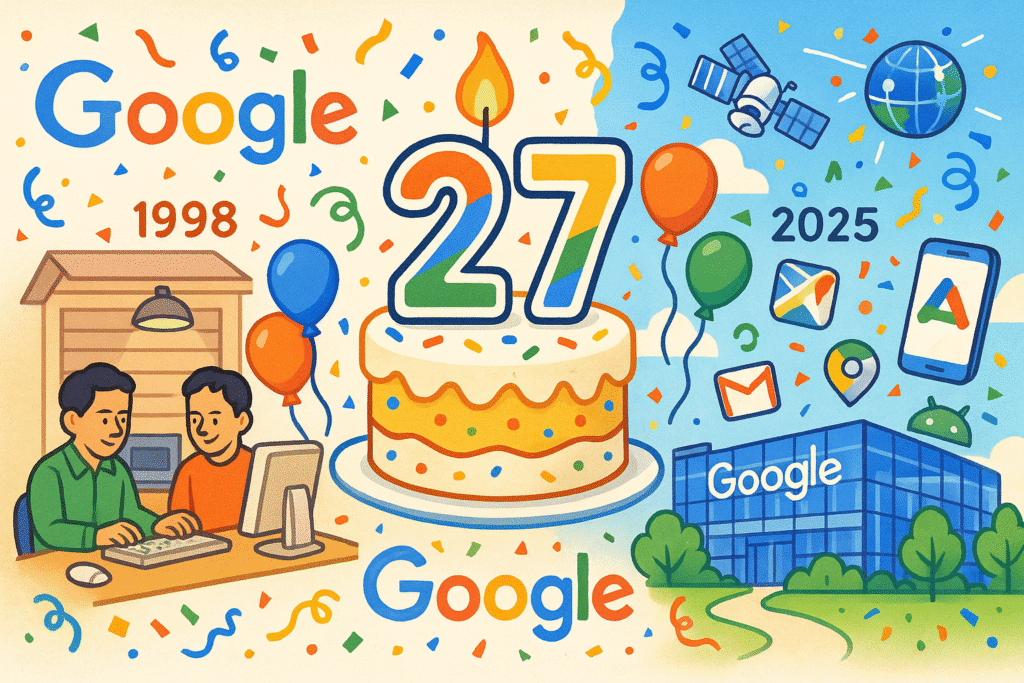
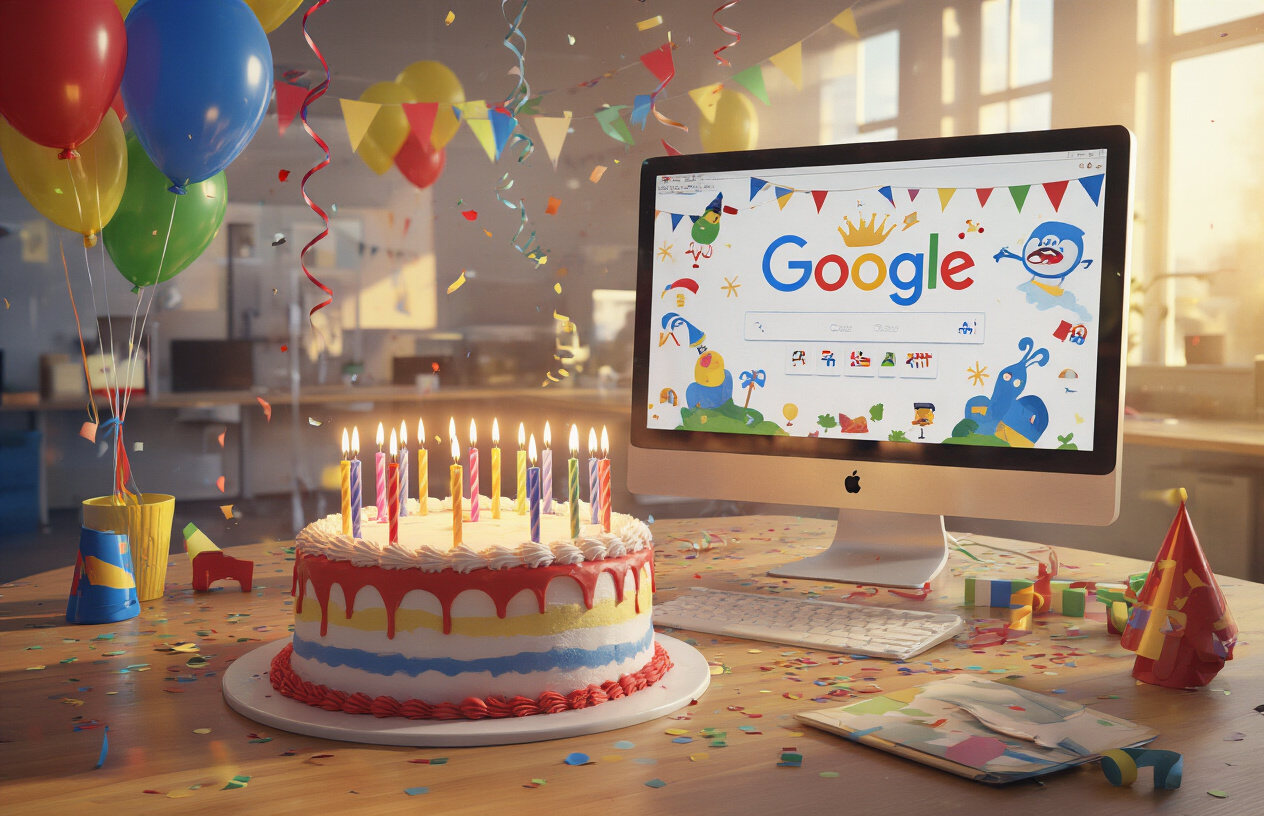
Google’s 27th birthday celebration showcases a remarkable journey back to its visual roots. The Google special doodle for this milestone anniversary features the company’s very first logo, created in 1998 when the search engine was just beginning to organize the world’s information. This vintage design serves as a powerful reminder of how far the Google company history has evolved while maintaining its core mission of making information universally accessible and useful.
The original 1998 logo represents more than just typography—it embodies the innovative spirit that would transform a simple research project into a global phenomenon. By featuring this nostalgic design, Google demonstrates its appreciation for the foundational elements that established its identity in the digital landscape. The vintage logo artwork creates a visual bridge between Google’s humble beginnings and its current position as a technological powerhouse.
September 27, 2025 Commemoration Across Google’s Homepage
The Google birthday celebration takes center stage on September 27, 2025, as the commemorative doodle launches across Google’s homepage worldwide. This date has become the official anniversary marker since 2006, despite the company’s actual incorporation occurring on September 4, 1998. The choice of September 27 reflects Google’s flexible approach to celebrating its founding, possibly tied to significant milestones in web indexing or other breakthrough achievements that occurred around this time.
The homepage transformation on this Google 27th birthday creates a unified global experience, allowing millions of users worldwide to participate in the celebration simultaneously. This widespread visibility demonstrates Google’s ability to connect with its vast user base through simple yet meaningful visual storytelling.
Tribute to Humble Garage-Based Beginnings and Breakthrough Moments
Google’s birthday doodle pays homage to the company’s extraordinary startup journey, emphasizing how breakthrough moments can emerge from the most ordinary places. The celebration specifically acknowledges Google’s origins as a research project that began in a garage—a testament to the entrepreneurial spirit that has become synonymous with Silicon Valley innovation.
This tribute resonates with the broader narrative of tech giant transformation, illustrating how Larry Page and Sergey Brin’s academic research project evolved into one of the world’s most influential companies. The garage symbolism represents more than just physical space; it embodies the scrappy determination and innovative thinking that characterized Google’s early days. By highlighting these humble beginnings, the birthday celebration reinforces the idea that revolutionary technologies often start with simple concepts and dedicated individuals willing to pursue their vision despite limited resources.
The Origin Story Behind Google’s Name and Identity

Evolution from original “BackRub” search engine concept
Before Google became the household name we know today, Larry Page and Sergey Brin launched their revolutionary search engine technology under a completely different moniker: “BackRub.” In 1996, this initial search engine earned its peculiar name through its innovative approach to web analysis. BackRub operated by examining the web’s “back links” to determine a website’s importance and understand its relationships with other sites across the internet.
The BackRub system represented a groundbreaking shift in search technology, focusing on link analysis rather than simple keyword matching. This approach allowed the search engine to evaluate website authority and relevance more effectively than existing alternatives. BackRub operated exclusively on Stanford University’s servers, where Page and Brin conducted their pioneering research. However, the system’s growing popularity and expanding capabilities eventually consumed too much bandwidth, forcing the duo to consider alternative hosting solutions and, consequently, a new identity for their creation.
Accidental misspelling that created the “Google” brand name
The transformation from BackRub to Google involved a fascinating case of accidental genius that would reshape internet history. In 1997, Larry Page and his officemates in room 360 of Stanford’s Gates Computer Science Building began brainstorming new names for their rapidly improving search technology. The final naming session occurred during September 1997, with Sean Anderson playing a crucial role in the process.
During this whiteboard brainstorming session, Anderson verbally suggested “googolplex” as a potential name, prompting Page to respond with the shortened version, “googol.” However, when Anderson sat at his computer to check domain name availability, he made a critical spelling error. Instead of searching for “googol.com,” he accidentally typed “google.com” and discovered it was available for registration. Page immediately embraced this misspelled version, finding it even more appealing than the original mathematical term. Within hours, he registered “google.com” for himself and Sergey Brin on September 15, 1997, officially establishing the Google brand identity.
Mathematical inspiration from “googol” representing infinite information
The Google origin story reveals deep mathematical inspiration rooted in the concept of handling immense amounts of data. The original name suggestion “googol” refers to the mathematical term representing the digit 1 followed by 100 zeroes, while “googolplex” represents 1 followed by a googol of zeroes. These astronomical numbers perfectly captured Page and Brin’s vision of indexing vast quantities of web information.
The mathematical foundation behind the naming process reflected the founders’ academic background and their ambitious goal of organizing the world’s information. The googol concept symbolized their understanding that the internet contained virtually infinite data points requiring systematic organization and retrieval. This mathematical inspiration aligned perfectly with their search engine’s core mission: making sense of an immense digital universe and providing users with relevant, authoritative results from billions of web pages.
Understanding Google’s Birthday Date Selection

Official incorporation on September 4, 1998 versus celebration date
The Google birthday celebration reveals an interesting discrepancy that has puzzled many observers over the years. Google was officially incorporated on September 4, 1998, when Stanford PhD students Larry Page and Sergey Brin formalized their company structure. However, the actual birth of Google can be traced back to August 1998, when Sun Microsystems co-founder Andy Bechtolsheim wrote a $100,000 check to the founders, marking the formal beginning of Google Inc.
Despite September 4 being the official incorporation date, Google consistently celebrates its birthday on September 27, creating a three-week gap that requires explanation. This date selection wasn’t arbitrary but reflects the company’s evolution from a simple search engine project to a comprehensive technology platform.
September 27 significance tied to search index milestone achievement
The choice of September 27 for Google’s birthday celebration is deeply connected to a pivotal moment in the company’s technical development. According to official information, this date commemorates a significant milestone in the growth of Google’s search index, symbolizing the platform’s rapid expansion and capability enhancement.
This milestone represented a breakthrough moment when Google’s search technology demonstrated its potential to handle vast amounts of web information effectively. The achievement around this time period showcased the superior indexing capabilities that would eventually distinguish Google from its competitors and establish its dominance in the search market.
Mid-2000s decision to establish consistent annual celebration
Google’s approach to its birthday celebration wasn’t consistent from the beginning. In the early 2000s, the company marked its birthday on different dates throughout September, creating confusion about the actual celebration date. This variability was possibly tied to various early milestones or public announcements that held significance for the company’s development.
The decision to standardize came in the mid-2000s, specifically since 2006, when Google established September 27 as its consistent annual celebration date. This standardization reflected the company’s growing maturity and desire for brand consistency. By choosing this date over the official incorporation date, Google demonstrated that it valued technical achievements and user-facing milestones over purely administrative formalities. The consistent celebration date has since become an integral part of Google’s cultural identity, marked annually with special doodles that reflect on the company’s remarkable journey from a garage startup to one of the world’s most influential technology companies.
Google’s Transformation from Startup to Tech Giant
Stanford PhD students Larry Page and Sergey Brin’s founding vision
The Google startup journey began in 1996 when two Stanford University PhD students, Larry Page and Sergey Brin, developed an innovative search engine called “Backrub.” Their revolutionary approach focused on link analysis, fundamentally changing how search engines would evaluate and rank web pages. Unlike existing search engines that primarily relied on keyword matching, Page and Brin’s system analyzed the relationships between websites through their linking patterns.
By 1998, their vision materialized into Google Search, featuring a minimalist interface that prioritized functionality over flashy graphics. This clean, user-focused design philosophy would become a hallmark of Google’s approach to product development. The company’s founding marked the beginning of what would become one of the most significant tech giant transformations in history.
Mission to organize world’s information and make it universally accessible
Google’s founding vision centered on organizing the world’s information and making it universally accessible. This ambitious mission drove the company’s rapid expansion beyond its initial search capabilities. The founders recognized that access to information should be democratic and efficient, leading to innovations that would reshape how billions of people interact with digital content.
This core mission became the foundation for Google’s systematic approach to product development and expansion. The company’s commitment to making information accessible influenced every major decision, from maintaining a simple search interface to developing new technologies that could handle the exponential growth of online content.
Expansion beyond search into Gmail, Maps, Chrome, and YouTube ecosystem
Now that we have covered Google’s foundational vision, let’s examine how the company expanded its ecosystem. Google’s transformation from a startup to tech giant involved strategic diversification across multiple digital services.
In 2001, Google launched Image Search, marking its first major expansion beyond traditional web search. The company’s growth accelerated in 2003 with the introduction of AdWords, which revolutionized online advertising and established Google’s primary revenue source. This financial foundation enabled further expansion into various services.
2004 proved pivotal when Google went public, raising $1.67 billion in its IPO, and simultaneously launched Gmail. The following year saw the acquisition of Android for $50 million and the launch of Google Maps and Google Earth, enhancing location-based services.
Google’s acquisition strategy reached new heights in 2006 with the purchase of YouTube, expanding its reach into video content and user-generated media. The company also introduced Google Docs and Sheets, promoting collaboration in productivity tools.
The launch of Google Chrome in 2008 represented another significant expansion, introducing an open-source browser that would eventually dominate the market. By 2011, Google had solidified its status as the world’s most popular search engine, with its sites including Gmail and YouTube surpassing one billion unique visitors, demonstrating the success of its ecosystem approach.
Google Doodles Legacy and Cultural Impact
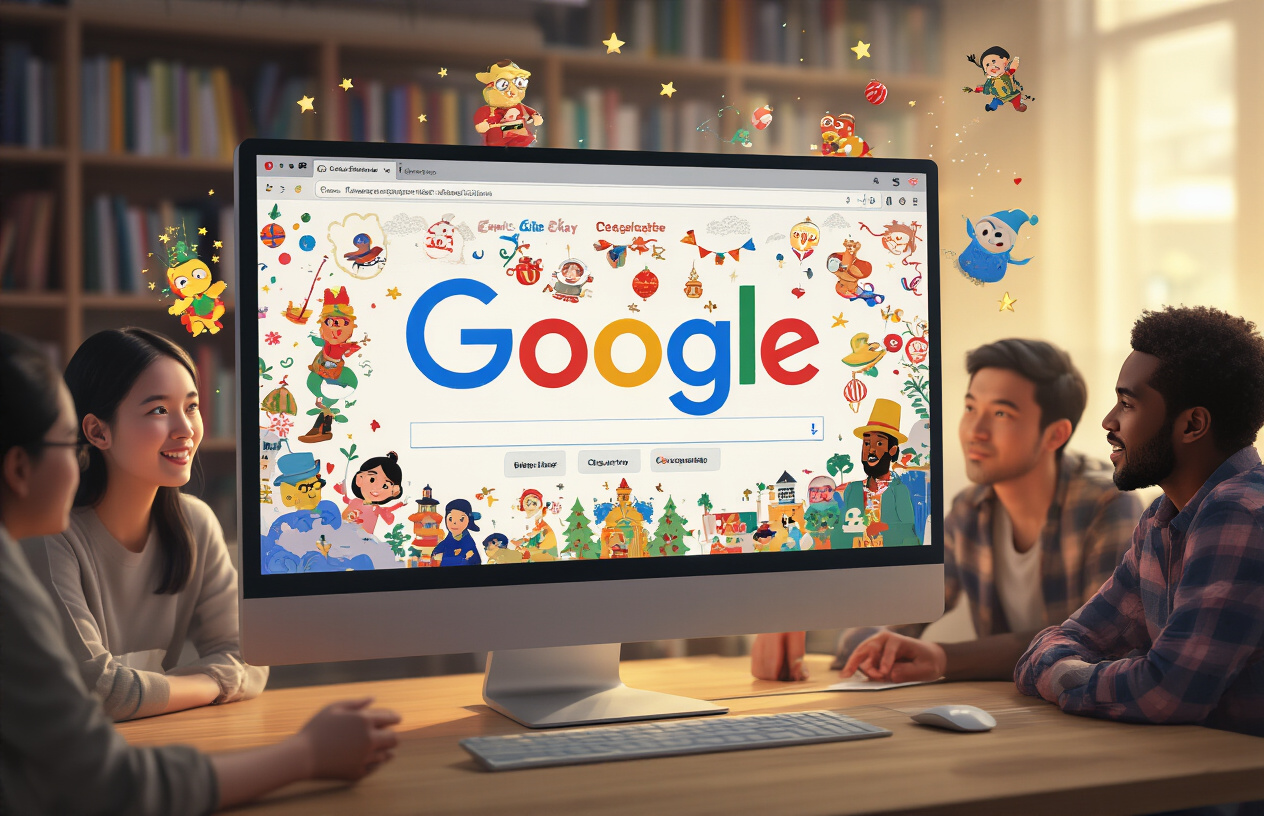
First Doodle as “out of office” message during founders’ vacation
The Google Doodles legacy began with a remarkably humble origin in 1998, when Google co-founders Larry Page and Sergey Brin needed a creative solution for a simple workplace dilemma. Planning to attend the annual Burning Man festival in Nevada, they required a clear way to communicate their absence to Google users without resorting to traditional “out of office” messages.
Their innovative approach involved replacing the second “O” in the Google homepage logo with the distinctive Burning Man logo—a simple stick figure drawing placed behind the letter. This playful modification served as both a notification and the birth of what would become one of the internet’s most beloved traditions. Remarkably, this first Doodle launched less than one week before Google was officially incorporated as a company, making Google Doodles technically older than Google, Inc. itself.
Evolution from simple designs to animated and interactive experiences
Now that we have covered the humble beginnings, the transformation of Google Doodles over the decades represents a remarkable journey of technological and artistic innovation. What started as a basic stick figure has evolved into sophisticated multimedia experiences that push the boundaries of web-based creativity.
The evolution timeline showcases dramatic milestones:
- 2000: Introduction of the first Doodle series featuring aliens encountering the Google logo
- 2000: Halloween marked the debut of animated elements with flashing Jack-o-lantern O’s and an eight-legged friend
- 2010: The groundbreaking interactive Pac-Man Doodle celebrated the game’s 30th anniversary, featuring a fully playable version embedded within the Google logo
- 2011: Full video productions emerged, beginning with a live-action tribute to Charlie Chaplin’s 122nd birthday
- 2018: Virtual reality capabilities arrived with the first VR/360 video Doodle honoring Georges Méliès
- 2019: Artificial intelligence integration appeared in the Bach Doodle, allowing users to compose melodies harmonized by machine learning
- 2021: The massive multiplayer experience “Doodles Champion Island” brought global users together in an expansive game world
This progression demonstrates how Google Doodles have consistently embraced emerging technologies, transforming from static illustrations into dynamic, interactive experiences that engage millions worldwide.
Global reach with hundreds of Doodles launching worldwide annually
With this technological evolution in mind, the Google cultural impact has expanded exponentially through international reach and cultural celebration. Beginning in 2000 with the first international Doodle celebrating Bastille Day in France, Google’s artistic expressions now span the globe with remarkable diversity and frequency.
The scale of this global phenomenon is impressive:
- Over 5,000 Doodles have been created throughout the decades
- Hundreds of Doodles launch around the world every year
- Multiple different Doodles can be live simultaneously in different regions, reflecting local culture, events, and histories
- The dedicated team consists of in-house artists (called “Doodlers”), engineers, designers, program managers, marketers, and cultural consultants
- Partnerships with local guest artists and creators from around the globe help bring authentic cultural representation to life
The Google birthday celebration tradition through Doodles has become a cultural touchstone, fostering curiosity, education, and cultural appreciation among internet users. These artistic expressions spark conversations, inspire learning, and celebrate diverse voices and experiences from around the world. By highlighting historical events, important figures, and cultural traditions, Google Doodles contribute to a richer understanding of global heritage and promote connection and unity among users worldwide.
The team receives thousands of global ideas annually from both internal Googlers and the public, with a committee carefully crafting an annual list through research, discussion with cultural consultants, and collaboration with local experts to ensure authentic representation of topics celebrating the world’s rich diversity.

Google’s 27th birthday celebration reminds us of the extraordinary journey from a garage-based startup called “BackRub” to becoming one of the world’s most influential technology companies. The special doodle featuring Google’s original 1998 logo perfectly captures this transformation, highlighting how the company has evolved from Larry Page and Sergey Brin’s Stanford research project into a global powerhouse that organizes the world’s information. The fascinating story behind Google’s name—born from a misspelling of “googol”—demonstrates how breakthrough moments can emerge from the most unexpected circumstances.
As Google continues to expand its ecosystem beyond search into Gmail, Maps, Chrome, and cutting-edge AI innovations, the legacy of Google Doodles stands as a testament to the company’s creative spirit and cultural impact. The choice to celebrate on September 27th rather than the official incorporation date reflects Google’s focus on meaningful milestones that shaped its growth. This birthday celebration serves as inspiration that ordinary beginnings can lead to extraordinary achievements, proving that the next breakthrough innovation might be just around the corner.



Pingback: Assata Shakur Dies at 78: Revolutionary Activist JoAnne Chesimard's Journey from Black Panther Party to Cuba Exile - boointheusa.com