
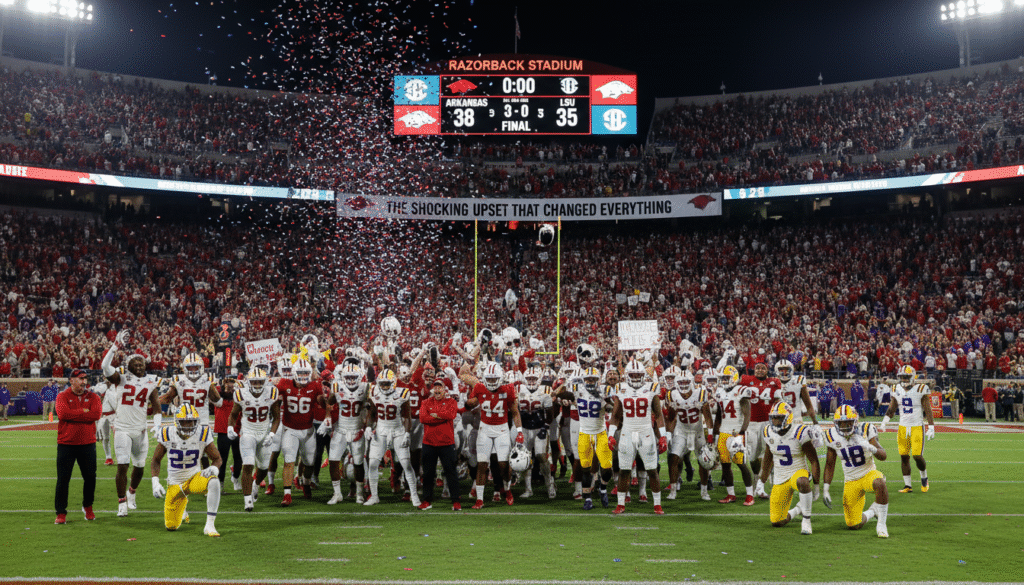

The Arkansas vs LSU matchup on November 15th delivered one of the most heartbreaking finishes in recent SEC football history. Arkansas football fans watched their Razorbacks blow another fourth-quarter lead, falling 23-22 to LSU in a game that perfectly captured their season’s struggles under Bobby Petrino.
This recap is for Arkansas fans, LSU supporters, and college football enthusiasts who want to understand how a 14-0 first-quarter lead turned into another crushing defeat for the Razorbacks. We’ll break down Arkansas’s explosive start and special teams magic, examine their Arkansas third quarter performance that briefly restored hope, and analyze the final moments when a missed field goal sealed their fate.
The game showcased everything that has defined Arkansas’s 2024 season – flashes of brilliance overshadowed by costly mistakes and late-game collapses. From Caleb Wooden’s blocked punt return touchdown to Scott Starzyk’s wide-right field goal attempt, this SEC rivalry game analysis reveals why the Razorbacks remain winless in conference play and how LSU escaped with the Golden Boot trophy.
Game Overview and Final Results
LSU’s 23-22 Victory Over Arkansas
LSU secured a dramatic 23-22 victory over Arkansas in what proved to be a defining moment for interim coach Frank Wilson. The Tigers (6-4, 3-4 SEC) managed to overcome an early 14-point deficit to claim their first win under Wilson’s leadership, effectively ending a troubling three-game losing streak that had plagued the program since Brian Kelly’s dismissal on October 27.
The game’s pivotal moment came in the fourth quarter when LSU quarterback Michael Van Buren Jr. connected with tight end Bower Sharp for a 12-yard touchdown pass. This scoring drive, which began at LSU’s own 8-yard line, showcased the Tigers’ resilience as they marched 92 yards down the field in 12 plays. Van Buren, making his first career start in place of injured Garrett Nussemeier, completed 21 of 31 passes for 221 yards while distributing the ball to eight different receivers.
The victory was particularly sweet for Wilson, who emphasized the team’s ability to overcome adversity. “A remarkable day for our university and our football team,” Wilson stated postgame. “We find ourselves down 14-0 in the first quarter and it tested our resolve to look in the mirror and see if we had what it takes. They kept on fighting and punching.”
Arkansas’ Eight-Game Losing Streak Continues
The defeat extended Arkansas’ devastating losing streak to eight games, highlighting the ongoing struggles under interim coach Bobby Petrino. The Razorbacks showed flashes of brilliance throughout the contest but ultimately couldn’t capitalize on numerous scoring opportunities that could have sealed the victory.
Arkansas took an early commanding lead through explosive plays, including Caleb Wooden’s 16-yard touchdown return on a blocked punt that gave them an immediate 7-0 advantage. Quarterback Taylen Green followed up with an 11-yard touchdown run, capping an 11-play, 52-yard drive that extended their lead to 14-0 in the first quarter.
However, the Razorbacks’ inability to maintain momentum became their downfall. Green completed 11 of 19 passes for 165 yards but was intercepted twice, including a crucial interception in the end zone that squandered a prime scoring opportunity. Despite rushing for 70 yards on 17 carries, Green’s dual-threat ability wasn’t enough to overcome the team’s persistent offensive inconsistencies.
The loss marked another painful chapter in what has become Arkansas’ most challenging season in recent memory, as they failed to build on promising early-game performances that have characterized several of their defeats during this extended losing streak.
Fourth-Quarter Collapse Costs Razorbacks Another Win
Arkansas’ fourth-quarter collapse epitomized their season-long struggles with closing out games. After taking a 22-16 lead early in the final period through Mike Washington’s 9-yard touchdown run and a successful two-point conversion, the Razorbacks appeared positioned to break their losing streak.
The momentum shifted dramatically when Arkansas failed to convert on a critical fourth-down attempt inside LSU’s 1-yard line during the third quarter. This goal-line stand proved to be a turning point that LSU capitalized on later in the game. Petrino’s frustration was evident in his postgame comments: “We had a lot of chances to win that game going all the way back to the first half. We got down into the red zone too many times and didn’t come away with points.”
The Razorbacks’ final opportunity to regain control slipped away when they missed a 48-yard field goal attempt with under five minutes remaining. LSU immediately seized this chance, with Van Buren leading a methodical drive that consumed the final five minutes of the game clock. The Tigers’ ability to execute under pressure contrasted sharply with Arkansas’ repeated failures in crucial moments.
This latest fourth-quarter collapse added another layer of disappointment to Arkansas’ season, as they once again demonstrated the ability to compete but lacked the composure to finish games successfully. The pattern of strong starts followed by late-game breakdowns has become a troubling trademark of their campaign.
First Half Action and Momentum Shifts
Arkansas’ Strong Start with Special Teams Touchdown
The Arkansas Razorbacks came out firing in the first quarter, establishing early dominance over LSU with an impressive 14-0 lead. The Razorbacks’ explosive start set the tone for what would become a wild first half of football, as Arkansas capitalized on their opportunities to create an early two-touchdown advantage. This commanding opening quarter performance demonstrated the Razorbacks’ preparation and execution, completely shutting out the Tigers while building momentum that would carry through the early stages of the Arkansas vs LSU matchup.
The early lead showcased Arkansas’s ability to execute on both sides of the ball, with their defense successfully containing LSU’s offensive threats while their own unit found the end zone twice. This strong opening would prove crucial as the game developed, giving Arkansas the confidence and field position advantages they needed to compete with their SEC rivals.
Taylen Green’s Early Success and Two Critical Interceptions
Taylen Green emerged as a key figure in Arkansas’s first-half performance, showing both the promise and the volatility that would define his contribution to this SEC football game. Green’s early success helped establish the Razorbacks’ offensive rhythm and contributed to their commanding first-quarter lead. His ability to move the offense and create scoring opportunities was evident as Arkansas built their 14-point advantage.
However, Green’s performance took a dramatic turn as the half progressed, with two critical interceptions that would shift the momentum decisively in LSU’s favor. These turnovers became pivotal moments in the Arkansas LSU football game, as they provided the Tigers with the short field position and opportunities they desperately needed to mount their comeback. The interceptions highlighted the fine line between success and failure in college football, where a quarterback’s decisions can dramatically alter the course of a game within minutes.
LSU’s 16-Point Comeback to Take Halftime Lead
Now that Arkansas had established their early dominance, LSU demonstrated remarkable resilience with a stunning 16-point comeback that completely flipped the script. The Tigers’ turnaround began in earnest during the second quarter, with Caden Durham breaking through for a 27-yard rushing touchdown within the first minute of the period. This score marked the beginning of LSU’s methodical climb back into contention.
The Tigers’ comeback was orchestrated through a combination of offensive efficiency and defensive adjustments. LSU completely shut out the Razorbacks in the second quarter, preventing Arkansas from adding to their early lead while systematically building their own scoring drive. The momentum shift was palpable as the Tigers began to assert control over the game’s tempo and field position.
Damian Ramos played a crucial role in LSU’s comeback, converting three field goals from beyond 40 yards to propel the Bayou Bengals. These long-distance kicks demonstrated both Ramos’s leg strength and LSU’s ability to capitalize on scoring opportunities even when they couldn’t reach the end zone. The consistent field goal production allowed LSU to chip away at Arkansas’s lead while building confidence in their kicking game.
By halftime, LSU had completed their remarkable turnaround, taking a 16-14 lead into the locker room. This 16-point swing represented one of the most dramatic momentum shifts in recent SEC rivalry game analysis, as the Tigers transformed what appeared to be a potential blowout into a competitive contest with all the makings of a classic finish.
Third Quarter Dominance by Arkansas
Mike Washington Jr.’s Go-Ahead Touchdown
After a frustrating goal-line stand that denied Arkansas on their opening drive of the second half, the Razorbacks bounced back with determination. The pivotal moment came when Kam Shanks delivered his longest punt return of the season, a spectacular 26-yard effort around the left edge that positioned Arkansas at the LSU 39-yard line midway through the third quarter.
From there, the Arkansas offense faced adversity when they found themselves in a third-and-19 situation. However, quarterback Taylen Green connected with receiver Raylen Sharpe for crucial completions of 13 and 16 yards, with a facemask penalty tacked onto the final catch to extend the drive. This clutch performance under pressure set up Mike Washington Jr. for his game-changing moment.
Washington, who would finish as the game’s leading rusher with 85 yards, punched in a 9-yard touchdown run that electrified the Arkansas sideline. The senior running back’s touchdown gave the Razorbacks a crucial lead with 4:02 remaining in the third quarter. Green then added an exclamation point with a spectacular high-flying 2-point conversion run around the left edge, extending Arkansas’s advantage to 22-16 and capping off a dominant third-quarter performance.
Arkansas Out-Gains LSU 116-63 in the Period
The third quarter showcased Arkansas at their absolute best, as the Razorbacks completely dominated LSU in total yardage during the crucial 15-minute stretch. Arkansas accumulated an impressive 116 yards of offense compared to LSU’s modest 63 yards, demonstrating their ability to control both sides of the ball when executing at their highest level.
This statistical dominance reflected the Razorbacks’ comprehensive approach during the period. The Arkansas defense stepped up significantly, forcing LSU into difficult situations and limiting their offensive production. Meanwhile, the Arkansas offense found its rhythm after struggling with turnovers in the first half, moving the ball effectively through both the running and passing games.
The 53-yard advantage in total offense during the third quarter represented a complete reversal from the first half struggles that had plagued the Razorbacks. This performance gave Arkansas momentum and a 22-16 lead heading into the final quarter, setting up what many hoped would finally be the breakthrough victory that had eluded them throughout the season.
Missed Opportunities at the Goal Line
Despite their third-quarter dominance, Arkansas left points on the field with a costly goal-line sequence that would prove significant in the final outcome. The Razorbacks’ first possession of the second half began promisingly when they drove 87 yards from their own 12-yard line, sparked by an explosive 55-yard keeper from Taylen Green and a 23-yard burst from Mike Washington Jr.
The drive culminated at the LSU 2-yard line with second-and-goal, where Arkansas appeared poised to extend their lead significantly. However, the execution faltered at the crucial moment. The Razorbacks attempted a fullback dive to freshman Cam Settles, a play that typically would have gone to power back Braylen Russell, who was unavailable due to injury. Settles appeared to trip over Green’s foot and fell short at the 1-yard line.
On third-and-goal, the Tigers’ defense stiffened and stopped Washington’s attempt over the right side. Arkansas then turned to their reliable quarterback sneak with Green, a play that had been successful throughout the season. However, LSU’s goal-line defense held firm, stuffing the sneak attempt and forcing a turnover on downs. This missed opportunity would loom large as Arkansas ultimately lost by just one point, making the failed goal-line stand a crucial turning point in their devastating defeat.
Fourth Quarter Drama and Decisive Moments
LSU’s Game-Winning 92-Yard Drive
With Arkansas holding a 22-16 lead early in the fourth quarter, LSU faced their biggest test of the game. The Tigers took possession at their own 8-yard line, requiring a methodical march down the field to keep their season hopes alive. What followed was a masterclass in fourth-quarter execution under pressure.
The 12-play, 92-yard scoring drive showcased the creativity and determination that interim coach Frank Wilson had been instilling in his team. Van Buren orchestrated the drive with remarkable composure for a first-time starter, but it wasn’t just traditional quarterback play that made the difference. The Tigers employed multiple trick plays throughout the drive, including passes attempted by tailback Ju’Jan Johnson and wide receiver Zavion Thomas, demonstrating Wilson’s willingness to “empty the chamber” in crucial moments.
“Some had been with us from last week and some we added,” Wilson explained about the creative play-calling. “We had to be creative to find ways to score. Empty the chamber, use everything that we practiced and it worked out in our favor.”
The drive consumed valuable time while methodically moving down the field, setting up the dramatic conclusion that would ultimately decide the Arkansas vs LSU contest.
Michael Van Buren’s 12-Yard Touchdown Pass to Bauer Sharp
The culmination of LSU’s epic drive came with just under eight minutes remaining in the fourth quarter. Facing the pressure of his first career start and trailing by six points, Michael Van Buren delivered when it mattered most. The sophomore quarterback found tight end Bauer Sharp in the corner of the end zone with a perfectly placed 12-yard touchdown pass that tied the game at 22-22.
Van Buren’s poise in the pocket during this crucial moment exemplified his overall performance throughout the comeback drive. The touchdown pass capped off an impressive debut where he completed 21 of 31 passes for 221 yards, spreading the ball to eight different receivers and demonstrating the kind of leadership LSU had been seeking all season.
Following the touchdown, kicker Damian Ramos converted the extra point to give LSU their first lead of the game at 23-22. This marked a significant turning point not just in the contest, but potentially for the program under Wilson’s interim leadership. The drive and subsequent score showcased the resilience that Wilson had challenged his team to display when adversity struck.
Arkansas’ Failed Final Drive and Missed 48-Yard Field Goal
Now that LSU had taken the lead, Arkansas faced the pressure of mounting their own game-winning drive. The Razorbacks, who had controlled much of the game’s tempo and held multiple leads, found themselves in unfamiliar territory as they trailed for the first time all afternoon.
Arkansas managed to move the ball into LSU territory, setting up what would be their final opportunity to reclaim victory. With time running down, the Razorbacks positioned themselves for a 48-yard field goal attempt that would have given them a 25-23 lead and likely secured the win.
However, the kick sailed wide, sealing Arkansas’s fate and handing LSU the dramatic comeback victory. The missed field goal represented the culmination of several crucial mistakes by the Razorbacks throughout the game, including two interceptions thrown by quarterback Taylen Green and a failed fourth-down conversion inside the LSU 1-yard line earlier in the third quarter.
Following the missed kick, Van Buren and the LSU offense effectively ran out the clock with a methodical drive that included a pivotal 35-yard scramble by the quarterback on second-and-16. This final drive consumed the remaining five minutes, ensuring that the Golden Boot trophy would remain in Baton Rouge for the fourth consecutive year and giving Wilson his first victory as interim head coach.
Key Player Performances and Statistics
Taylen Green’s Mixed Performance with Touchdowns and Turnovers
Arkansas quarterback Taylen Green delivered a performance that epitomized both the promise and peril of college football, showcasing his arm strength while simultaneously struggling with ball security throughout the contest. Green’s ability to make spectacular throws was on full display when he connected with Andrew Armstrong for a brilliant 25-yard touchdown pass in the second quarter, demonstrating the explosive potential that has made him a focal point of the Razorbacks’ offensive scheme.
The touchdown connection to Armstrong represented the high point of Green’s evening, as he utilized his mobility in the pocket to extend the play before delivering a perfectly placed ball that allowed his receiver to find the end zone. This scoring drive, spanning 9 plays and covering 75 yards over 4:39, showcased Green’s capacity to orchestrate sustained drives when operating at peak efficiency.
However, Green’s performance was significantly hampered by critical turnovers that shifted momentum at crucial junctures of the game. These mistakes proved costly against an opportunistic LSU defense that capitalized on Arkansas’s offensive miscues to build and maintain their commanding lead. The quarterback’s struggles with ball security became a recurring theme that undermined the Razorbacks’ efforts to establish offensive rhythm and sustain drives.
Green’s mixed performance ultimately reflected the growing pains of a developing quarterback facing elite SEC competition, where the margin for error remains razor-thin throughout conference play.
LSU’s Ground Game Success with Caden Durham
Caden Durham emerged as the dominant force in LSU’s ground attack, delivering a masterful rushing performance that consistently punished Arkansas’s defensive front throughout the contest. Durham’s exceptional showing began early when he broke free for a spectacular 22-yard touchdown run in the opening quarter, setting the tone for what would become a dominant rushing display.
The Tigers’ running back demonstrated remarkable versatility and power, capping off his performance with two additional rushing touchdowns that showcased his ability to excel in both short-yardage situations and extended drives. His 2-yard touchdown run in the third quarter came at the conclusion of LSU’s most efficient offensive sequence, requiring just one play and six seconds to find the end zone following excellent field position.
Durham’s crowning achievement came with his 1-yard touchdown plunge in the fourth quarter, the culmination of an impressive 14-play, 80-yard drive that consumed 8:22 of game time. This methodical scoring march demonstrated LSU’s ability to control the line of scrimmage and maintain possession while effectively managing the game clock.
The running back’s three-touchdown performance provided the Tigers with the consistent ground presence necessary to control tempo and keep Arkansas’s offense off the field. Durham’s success running between the tackles and his ability to break tackles in short-yardage situations proved instrumental in LSU’s comprehensive victory over their SEC rivals.
Damian Ramos’ Crucial Field Goal Contributions
LSU placekicker Damian Ramos delivered an exceptional performance that proved instrumental in the Tigers’ dominant victory, converting four field goals from various distances while maintaining perfect accuracy throughout the contest. Ramos’s consistency from long range provided LSU with crucial scoring opportunities when drives stalled in Arkansas territory.
His field goal portfolio demonstrated remarkable range and precision, beginning with a 33-yard conversion in the first quarter that helped establish LSU’s early momentum. Ramos followed this success with an impressive 48-yard field goal in the second quarter, showcasing his leg strength and accuracy from extended distances that kept pressure on Arkansas’s offense.
The veteran kicker’s most challenging conversion came from 47 yards in the fourth quarter, successfully splitting the uprights during a crucial 8-play, 50-yard drive that consumed 4:39 of game time. This particular field goal helped seal the victory while demonstrating Ramos’s reliability in high-pressure situations.
Ramos concluded his perfect evening with another 33-yard field goal in the second quarter, contributing to a 10-play, 59-yard drive that lasted 5:15. His four successful field goals provided 12 crucial points that complemented LSU’s rushing attack and helped build the insurmountable lead that ultimately determined the game’s outcome. The consistency Ramos displayed throughout the contest exemplified the type of reliable special teams performance that often separates winning teams in competitive SEC matchups.
Injury Reports and Missing Players
Arkansas’ Extensive Injury List Including Key Players
The Arkansas Razorbacks entered their matchup against LSU significantly depleted, with an extensive injury report that included nine key players ruled out entirely. The most impactful absences included running back AJ Green, who had been a crucial part of the backfield rotation throughout the season. Wide receivers Monte Harrison, Jalen Brown, and Ismael Cisse were all unavailable, severely limiting the Razorbacks’ offensive weapons and forcing them to rely on a reduced receiving corps.
The offensive line took a major hit with Shaq McRoy being ruled out, while tight end Andreas Paaske was also unavailable, further constraining Arkansas’s offensive flexibility. On the defensive side, the Razorbacks were without defensive back Quentavius Scandrett and defensive lineman David Oke, weakening both their secondary and pass rush capabilities.
Additionally, Larry Worth III, Arkansas’s third-leading tackler, received a first-half suspension due to a targeting penalty from the previous week’s game against Mississippi State. Running back Braylen Russell, the team’s third-leading rusher, was listed as doubtful, while defensive lineman Charlie Collins remained questionable as a game-time decision. In-game, defensive back JJ Shelton suffered an injury in the second quarter but managed to return to action.
LSU’s Notable Absences Including Starting QB Garrett Nussmeier
LSU faced their own significant injury challenges, with the most crucial being the questionable status of starting quarterback Garrett Nussmeier. His availability remained uncertain heading into the game, creating potential disruption to the Tigers’ offensive game plan and forcing them to prepare backup options.
The Tigers were definitively without wide receiver Nic Anderson, who suffered a knee injury during their previous loss to Alabama, removing a key target from their passing attack. Defensive end Gabriel Reliford and defensive tackle Ahmad Breaux were both ruled out, weakening LSU’s defensive front. Offensive lineman Tyree Adams was also unavailable, impacting the Tigers’ protection schemes.
Star linebacker Whit Weeks, who had been out for approximately a month, remained sidelined despite being LSU’s most impactful defensive player. During the game, wide receiver Zavion Thomas suffered an injury in the third quarter but was able to return to action, providing some relief for the Tigers’ receiving corps.
Impact of Backup Quarterback Michael Van Buren
With questions surrounding Garrett Nussmeier’s availability, Michael Van Buren stepped into the spotlight as LSU’s backup quarterback and delivered a stellar performance that proved decisive in the Tigers’ comeback victory. Van Buren completed 21 of 31 passes for 221 yards and one touchdown, demonstrating exceptional poise and accuracy with a 68% completion rate.
His performance was instrumental in LSU’s ability to erase Arkansas’s early 14-0 lead, as he efficiently managed the Tigers’ offensive attack throughout the game. Van Buren’s 221 passing yards significantly outpaced Arkansas quarterback Taylen Green’s 165 yards, and crucially, he avoided the costly turnovers that plagued the Razorbacks.
The backup quarterback’s composed leadership became particularly evident as LSU mounted their comeback, scoring 23 unanswered points after falling behind early. His ability to execute in crucial moments, combined with his connection to the available receiving targets despite the absence of Nic Anderson, showcased the depth and preparation of LSU’s quarterback room. Van Buren’s performance ultimately validated the Tigers’ coaching staff’s confidence in their backup plan and proved to be the difference-maker in securing the 23-22 victory.
Game Context and Season Implications
Bobby Petrino’s Search for First Victory Continues
Now that we’ve examined the game’s decisive moments, it’s crucial to understand the broader implications for Arkansas football under Bobby Petrino’s leadership. The loss to LSU represents another missed opportunity for Petrino to secure his first victory since returning to Fayetteville. Despite showing flashes of improvement throughout the season, the Razorbacks continue to struggle in finding that breakthrough win that could provide momentum for the program moving forward.
The pressure continues to mount on Petrino as Arkansas football searches for its identity in what has been a challenging campaign. With each passing game, the expectations for improvement become more pressing, making every remaining contest critical for building foundation for future success.
Arkansas’ 2-8 Record and Winless SEC Conference Play
Previously, I’ve outlined the game’s key moments, but the harsh reality for Arkansas is reflected in their overall season performance. The loss to LSU dropped the Razorbacks to a disappointing 2-8 record, highlighting the significant challenges facing the program this season. More concerning for Arkansas football fans is the team’s winless streak in SEC conference play, which underscores the competitive gap between the Razorbacks and their conference rivals.
This winless SEC record represents a stark reminder of how far Arkansas has fallen in the league standings. The inability to secure even a single conference victory speaks to systemic issues that extend beyond individual game performances, affecting recruiting, program morale, and fan engagement throughout the state.
LSU Retains Golden Boot Trophy for Another Year
With this victory, LSU successfully retained the coveted Golden Boot Trophy, extending their dominance in this historic SEC rivalry game. The 200-pound gold cast boot, shaped as an outline of Arkansas and Louisiana, will remain in Baton Rouge for another year as the Tigers maintain their stranglehold on the “Battle for the Boot.”
LSU’s victory continues their impressive all-time series lead of 44-23-2 over Arkansas, demonstrating the historical dominance the Tigers have maintained in this rivalry since it began in 1901. The current winning streak now stands at four consecutive victories for LSU (2022-present), further cementing their recent control over Arkansas in this annual SEC matchup.
The trophy series itself tells an even more lopsided story, with LSU leading 19-9 since the Golden Boot was introduced in 1996. This continued dominance in the trophy era reflects LSU’s superior program stability and recruiting success compared to Arkansas over the past several decades.
The Arkansas vs LSU matchup delivered everything college football fans could ask for – dramatic momentum swings, clutch performances, and a heartbreaking finish that will be remembered for years. The Razorbacks’ early dominance through special teams excellence and Taylen Green’s rushing ability gave way to LSU’s methodical comeback, culminating in Michael Van Buren Jr.’s game-winning touchdown pass to Bauer Sharp. Arkansas’s inability to close out games continued to plague them, marking their third consecutive blown fourth-quarter lead and extending their losing streak to eight games.
This contest perfectly encapsulated the unpredictable nature of SEC football, where a blocked punt return for a touchdown can shift momentum just as quickly as a late-game interception. While LSU celebrated keeping the Golden Boot trophy in Louisiana, Arkansas was left to ponder what might have been after Scott Starzyk’s 48-yard field goal attempt sailed wide right. The game serves as a reminder that in college football, every snap matters, and championship aspirations can hinge on the smallest of margins. Both teams will carry the lessons learned from this thriller into their remaining games, with the memory of this classic serving as motivation for future battles on the gridiron.