

Table of Contents

Accenture’s recent workforce reduction has sent shockwaves through the tech consulting industry, affecting thousands of employees and signaling a major strategic shift. This comprehensive analysis is for current and former Accenture employees, job seekers in the consulting sector, and industry professionals tracking workforce trends in the age of AI automation.
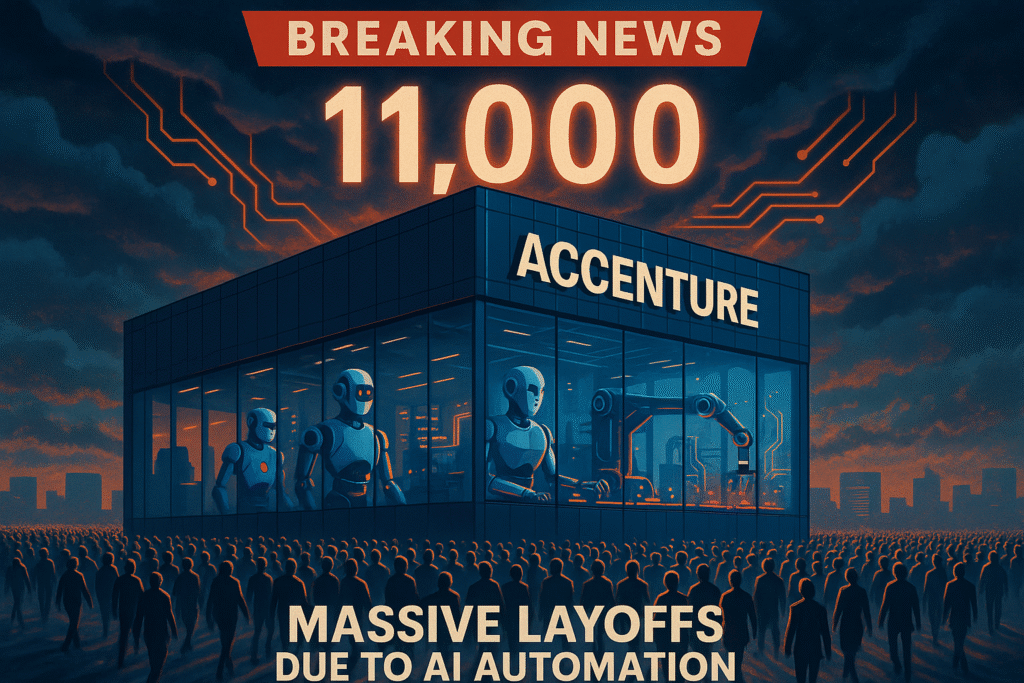
The global consulting giant has cut over 11,000 jobs in just three months as part of an $865 million restructuring program, with CEO Julie Sweet warning that employees who can’t be retrained for AI-focused roles face termination. These accenture layoffs reflect broader challenges facing traditional consulting models as companies pivot toward artificial intelligence and automation.
We’ll examine the scale and timeline of these workforce reductions, break down the financial impact driving these cost cutting measures, and explore how Accenture’s AI-driven strategy is reshaping job requirements. You’ll also discover what market pressures are forcing this restructuring and how the company plans to rebuild its workforce around future capabilities while maintaining performance targets.
Scale and Timeline of Accenture’s Workforce Reduction

Over 11,000 employees laid off in three months
The scale of Accenture’s workforce reduction has been unprecedented in the consulting industry. The global consulting giant implemented massive accenture layoffs that affected more than 11,000 employees across the globe within a three-month period. These accenture job cuts represent a significant portion of the company’s workforce and demonstrate the aggressive nature of the restructuring initiative.
The company’s leadership has been transparent about the reasoning behind these extensive accenture employee terminations. According to CEO Julie Sweet, the organization is “exiting people on a compressed timeline where reskilling is not a viable path for the skills we need.” This approach indicates that the company prioritized speed over gradual workforce transformation, leading to swift and substantial job eliminations across various departments and geographic locations.
Global headcount dropped from 791,000 to 779,000 by August
The numerical impact of the accenture workforce reduction becomes clear when examining the company’s official headcount figures. At the end of August, Accenture’s global workforce stood at 779,000 employees, marking a substantial decrease from the 791,000 employees recorded just three months earlier. This reduction of 12,000 positions represents approximately 1.5% of the company’s total workforce.
This dramatic shift in workforce numbers reflects the company’s strategic pivot toward AI-driven solutions and demonstrates how quickly large organizations can reshape their human resources when faced with technological disruption and changing market demands.
Restructuring program extends through November 2025
The current accenture restructuring initiative is not a short-term adjustment but rather an extended transformation program. The layoffs that began earlier in 2024 are expected to continue until November 2025, indicating a prolonged period of workforce optimization and organizational change.
This extended timeline suggests that Accenture is taking a methodical approach to its accenture downsizing strategy, allowing the company to carefully assess market conditions, client demands, and technological developments as they continue to reshape their workforce. The restructuring program is part of an $865 million initiative that primarily covers severance costs and is projected to save the company more than $1 billion overall.
The company has warned that more exits are likely in the coming months, indicating that additional waves of accenture layoffs 2024 may continue as the organization aligns its workforce with evolving client expectations for AI-driven solutions and services.
Financial Impact and Cost Structure of the Layoffs

$865 million restructuring program implementation
Accenture has launched a comprehensive six-month business optimization program valued at $865 million, marking one of the most significant restructuring initiatives in the company’s recent history. This substantial investment reflects the company’s strategic commitment to realigning its workforce and operations to meet the evolving demands of the AI-driven market landscape.
The restructuring program encompasses various cost components, with severance payments and headcount reductions forming the primary elements of this financial commitment. CEO Julie Sweet outlined during earnings calls that this optimization program is designed to accelerate the company’s transformation while positioning Accenture for sustainable growth in an increasingly AI-centric business environment.
$615 million in severance costs for last quarter
The financial impact of Accenture’s workforce reduction became immediately apparent with $615 million allocated specifically for severance costs in the most recent quarter. These substantial severance expenses represent the company’s commitment to providing appropriate compensation packages for departing employees as part of their strategic workforce optimization.
CFO Angie Park emphasized that these severance costs, while significant, are essential investments in the company’s future trajectory. The substantial financial outlay demonstrates Accenture’s approach to managing workforce transitions responsibly while ensuring compliance with employment regulations across various global markets where the company operates.
Additional $250 million expected in current quarter
Beyond the initial $615 million in severance costs, Accenture anticipates an additional $250 million in restructuring-related expenses for the current quarter. This projected expenditure brings the total restructuring investment closer to the full $865 million program commitment, indicating the comprehensive nature of the workforce transformation initiative.
These additional costs encompass various aspects of the restructuring process, including remaining severance obligations, operational adjustments, and other transition-related expenses. The phased approach to these expenditures allows Accenture to manage cash flow while maintaining operational continuity during the transformation period.
Projected savings of over $1 billion for the company
The significant upfront investment in restructuring is projected to generate savings exceeding $1 billion for Accenture, creating a favorable return on investment for the comprehensive workforce optimization program. CFO Angie Park specifically stated that the company expects “savings of over $1 billion from our business optimization program,” highlighting the long-term financial benefits of the current restructuring efforts.
These projected savings will be strategically reinvested back into the business and workforce development initiatives, particularly focusing on AI capabilities and skills enhancement. Park noted that the company plans to “reinvest that while still delivering modest margin expansion,” demonstrating Accenture’s commitment to balancing cost optimization with strategic growth investments. This reinvestment strategy ensures that the financial benefits from workforce restructuring directly support the company’s transformation into a more AI-focused organization while maintaining competitive market positioning.
AI-Driven Strategic Shift Behind Job Cuts

Compressed timeline for employee reskilling initiatives
The rapid advancement of generative AI has created an unprecedented urgency for workforce transformation at Accenture. With AI technology evolving at breakneck speed—where innovations like ChatGPT captured global attention within hours—the traditional timelines for employee reskilling have been dramatically compressed. The company recognizes that mastering generative AI is not a one-time event but requires dynamic, continuous learning approaches.
Accenture has implemented comprehensive learning initiatives that embrace a three-dimensional learning model: individual, organizational, and machine learning. This approach requires humans to teach machines while simultaneously developing new skills themselves, creating a teach-to-learn culture that accelerates knowledge transfer across the organization. The compressed timeline reflects the reality that 97% of executives acknowledge the transformative nature of generative AI for their companies, with 100% anticipating changes to their workforce structure.
Focus on skills alignment with artificial intelligence demands
Now that we have covered the compressed timeline challenges, the strategic focus has shifted toward aligning employee capabilities with AI-driven market demands. Accenture’s workforce transformation strategy centers on ensuring skills and adaptability—of both humans and machines—keep pace with changes across the entire value chain.
The company’s approach involves leveraging tools and technologies like skill mapping and ontology to facilitate smooth transitions from declining to emerging roles. As work and roles shift due to AI integration, this creates increased capacity that frees up time and talent for transitions and new role creation that best aligns with strategic customer and business outcomes. This increased capacity serves as the unlock for the productivity and market share gains that executives predict will stem from generative AI implementation.
$5.1 billion in generative AI project bookings for the year
With this strategic alignment in mind, Accenture has demonstrated remarkable success in monetizing its AI transformation efforts. The company secured $5.1 billion in generative AI project bookings, reflecting the massive market demand for AI-driven consulting services and solutions.
This substantial revenue figure underscores how organizations across industries are racing to integrate generative AI into their operations. At 81% of companies, generative AI is viewed as one of the main levers for business reinvention, creating unprecedented demand for Accenture’s specialized services. The booking success validates the company’s strategic decision to invest heavily in AI capabilities while simultaneously restructuring its workforce to meet these evolving market needs.
Growth from 40,000 to 77,000 AI and data professionals
Previously, we’ve seen how Accenture compressed reskilling timelines and secured significant AI project bookings. The most tangible evidence of this transformation lies in the dramatic expansion of the company’s AI and data professional workforce, growing from 40,000 to 77,000 specialists.
This 92.5% increase in AI-focused professionals represents one of the most significant workforce reallocations in the consulting industry. The expansion demonstrates Accenture’s commitment to building capabilities that align with the generative AI revolution, where 44% of working hours are potentially in scope for automation or augmentation according to their modeling.
The growth strategy reflects the company’s understanding that generative AI democratizes business process redesign, giving everyone from assembly workers to customer service agents the power to reshape their own workflows. By investing in AI and data professionals, Accenture positions itself to guide clients through this transformation while ensuring its own workforce remains at the forefront of technological innovation. This strategic workforce expansion, coupled with the concurrent layoffs in traditional roles, illustrates the fundamental shift occurring across the consulting landscape as companies adapt to AI-driven market demands.
Market Challenges Driving the Restructuring

Reduced Corporate Demand for Consulting Projects
The consulting industry is experiencing a significant downturn in corporate demand, with widespread implications for firms like Accenture. Recent industry reports indicate that client demand over the past six months has largely held steady or declined, with only 25% of consulting firms noting a slight increase in project requests. This reduced appetite for consulting services reflects broader economic uncertainty, as companies become increasingly cautious about their spending on external advisory services.
Client budgets continue to tighten across the board, with all surveyed consulting firms reporting either slight or significant decreases in client spend. This budget compression forces companies to be more selective about their consulting engagements, often prioritizing only the most critical initiatives. The shift represents a stark contrast to the growth-driven hiring spree that consulting firms experienced during and immediately after the COVID-19 pandemic, when unprecedented client demand led to aggressive expansion.
Decreased US Federal Government Spending Affecting Revenue
Government spending patterns have undergone notable changes that directly impact consulting revenue streams. The August budget deficit fell 9% year-over-year to $345 billion, though the year-to-date deficit remains near $2 trillion, signaling ongoing fiscal strain. This fiscal pressure translates into reduced government contracting opportunities for major consulting firms.
EY’s Oceania business exemplifies this trend, reporting a 10.3% decline in consulting revenue attributed specifically to lower government spending, delayed technology projects, and cautious client behavior. Similarly, KPMG has restructured its consulting division and appointed new leadership to navigate what executives describe as a “consulting winter,” largely driven by project slowdowns in non-U.S. markets and reduced public sector investment.
Shift from Short-term Consulting to Long-term Digital Transformation
The consulting landscape is experiencing a fundamental shift in project types and duration. While traditional short-term strategic consulting engagements are declining, there’s growing momentum in technology, digital transformation, AI, and advanced analytics initiatives. However, this transition presents challenges as clients are launching larger, multi-year transformations with heightened expectations for speed and digital impact.
Strategy consulting, once a cornerstone of the industry, has been repeatedly cited as a shrinking practice area, along with M&A and ESG consulting. Instead, clients are gravitating toward outcome-based projects that promise measurable results over extended timeframes. This shift requires consulting firms to restructure their service delivery models and invest heavily in specialized capabilities, creating additional pressure on traditional consulting margins.
The transformation also reflects clients’ growing preference for building internal capabilities rather than relying solely on external consultants. Many organizations are establishing in-house teams to handle ongoing digital initiatives, reserving external consulting for specialized expertise or large-scale implementations.
Revenue Growth Projection of Only 2-5% for Upcoming Fiscal Year
The consulting industry faces severely constrained growth prospects, with revenue forecasts remaining pessimistic across the sector. According to recent industry surveys, 75% of consulting firms expect revenues to either decline or remain flat over the next two years. This projection represents a dramatic shift from the robust growth patterns that characterized the industry over the previous decade.
The modest 2-5% revenue growth projection reflects multiple converging factors: longer sales cycles, greater price sensitivity among clients, and hesitancy to launch new initiatives. Clients are demonstrating increasing resistance to premium pricing models, forcing consulting firms to reconsider their fee structures and value propositions.
Regional variations further complicate growth projections, with some markets showing more resilience than others. The UK’s consulting industry, which stagnated in 2024, is projected to grow by 3.6% in 2025 and accelerate to 7.8% in 2026, driven primarily by AI adoption, cost-efficiency programs, and cybersecurity upgrades. However, this growth remains modest compared to the 2021-23 boom period, indicating that the industry’s expansion trajectory has fundamentally shifted toward more conservative projections.
Investment in Future Workforce Capabilities

Agentic AI Training Programs for Remaining Employees
Now that we have covered the market challenges driving Accenture’s restructuring, it’s essential to examine how the company is investing in its remaining workforce. Accenture has implemented comprehensive agentic AI training programs, having already reskilled 550,000 workers on the fundamentals of generative artificial intelligence. CEO Julie Sweet emphasized that as “advanced AI becomes a part of everything we do,” employees are expected to “retrain and retool” at scale.
The company’s approach to AI training goes beyond basic exposure, focusing on practical applications where AI systems can operate autonomously to achieve specific goals. This strategic investment ensures that retained employees can effectively collaborate with and manage AI-driven processes across client engagements.
Upskilling Initiatives for Complex Task Automation
With the workforce reduction underway, Accenture is simultaneously doubling down on upskilling initiatives designed to prepare employees for complex task automation scenarios. The company’s “No. 1 strategy is upskilling,” according to Sweet, who noted that Accenture has significant experience in workforce development programs.
These initiatives target specific skill gaps where human expertise remains crucial in implementing and managing automated systems. The focus extends beyond simple AI familiarity to developing capabilities in designing, deploying, and optimizing AI solutions for complex business challenges that clients face in their digital transformation journeys.
Plans for Overall Headcount Growth in Coming Year
Despite the current accenture workforce reduction, the company has announced plans for overall headcount growth in the upcoming financial year. Sweet confirmed that Accenture expects to increase its workforce across all markets, including the United States and Europe, signaling confidence in future business expansion.
This growth strategy reflects the company’s belief that AI represents an “expansionary” rather than “deflationary” force in the consulting industry. The planned increases demonstrate Accenture’s commitment to scaling operations while simultaneously optimizing its talent composition for the AI era.
Continued Focus on AI and Data Expertise Development
Accenture’s investment in future workforce capabilities centers heavily on AI and data expertise development. The company has nearly doubled its ranks of AI and data professionals to 77,000 in 2025, up from 40,000 in 2023, representing a significant 92.5% increase in specialized talent.
This strategic focus on AI and data capabilities positions Accenture to capitalize on what Sweet describes as “massive client demand to deploy artificial intelligence across organizations.” The company recognizes that while CEOs and boards understand that “advanced AI is critical to the future,” most companies are “not yet AI ready,” creating substantial opportunities for specialized consulting services.
The continued emphasis on developing these expertise areas ensures that accenture restructuring efforts align with long-term market demands, positioning the company as the partner of choice for organizations seeking to implement advanced AI solutions effectively.
Company Performance Despite Workforce Changes

7% Revenue increase to $17.6 billion in Recent Quarter
Despite the accenture workforce reduction measures implemented throughout the year, Accenture demonstrated remarkable financial resilience with a substantial 7% revenue increase, reaching $17.6 billion in their most recent quarterly reporting period. This growth trajectory indicates that the company’s accenture restructuring strategy has successfully maintained operational momentum while optimizing cost structures. The revenue expansion occurred across multiple business segments, suggesting that client demand for Accenture’s consulting and technology services remained robust even as the organization underwent significant internal changes.
Net Income Growth of 6% to $7.83 billion Annually
Moving beyond quarterly performance, Accenture’s full-year results reveal a 6% increase in net income, totaling $7.83 billion annually. This impressive financial metric demonstrates that the accenture cost cutting measures, while impacting thousands of employees, have effectively contributed to enhanced profitability. The company’s ability to grow net income alongside revenue expansion suggests successful operational efficiency improvements, particularly in how resources are allocated and utilized across global operations. These results came in ahead of company expectations, validating management’s strategic approach to balancing workforce optimization with sustained business growth.
Maintained Operating Profit Margin Expansion Strategy
Now that we have covered the revenue and net income performance, it’s essential to examine how Accenture maintained its operating profit margin expansion strategy throughout this period of organizational change. The company’s disciplined approach to margin management enabled them to preserve profitability levels while investing in future capabilities. This strategic focus on margin expansion has been particularly crucial during the accenture layoffs period, as it provided the financial flexibility needed to support both immediate restructuring costs and long-term strategic investments in emerging technologies and market opportunities.
Stock Performance Impact with Shares at Lowest Since November 2020
With this financial backdrop in mind, Accenture’s stock performance presents a contrasting narrative to the company’s operational success. Despite strong revenue growth and improved profitability, shares have declined to their lowest levels since November 2020, reflecting investor concerns about the broader implications of the accenture downsizing strategy. Market sentiment appears to be influenced by uncertainty regarding the long-term impact of workforce reductions on service delivery capabilities and competitive positioning. This disconnect between operational performance and stock valuation highlights the complex market dynamics surrounding companies implementing significant restructuring initiatives, even when financial results exceed expectations.

Accenture’s strategic workforce restructuring reflects the broader transformation reshaping the consulting industry. With over 11,000 layoffs in just three months and an $865 million restructuring program, the company is aggressively realigning its talent base to meet AI-driven market demands. Despite revenue growth of 7% and strong performance in generative AI projects worth $5.1 billion in new bookings, the company faces compressed timelines for reskilling employees who cannot adapt to the evolving skill requirements.
The path forward demonstrates both the opportunities and challenges of the AI revolution in professional services. While Accenture continues expanding its AI and data expertise from 40,000 to 77,000 professionals, the human cost of this transformation is significant. For organizations navigating similar changes, Accenture’s approach underscores the critical importance of proactive workforce development and strategic investment in future capabilities to remain competitive in an AI-first business landscape.



Pingback: Google 27th Birthday 2025: Special Doodle Celebrates Tech Giant Transformation from Startup Journey to Cultural Impact - boointheusa.com